Understanding the Prisma Health 403(b) Retirement Savings Plan
IntelliVest Wealth Management is not affiliated with, endorsed by, or sponsored by Prisma Health, Empower, Empower Annuity Insurance Company of America, or The Variable Annuity Life Insurance Company. All trademarks are the property of their respective owners. This article is provided for educational purposes only and is not a solicitation, an offer, or individualized investment advice. Plan provisions change; always confirm details against your official plan documents. Plan details described here are drawn from the plan's audited financial statements for the plan year ended December 31, 2024. Please see the
.
What is the Prisma Health Retirement Savings Plan?
The Prisma Health Retirement Savings Plan is a 403(b) plan — the nonprofit equivalent of a 401(k). It's where the money you contribute from your paycheck goes.
It covers substantially all Prisma Health employees who aren't independent contractors. That's broader than the companion 401(a) plan, which is limited to Prisma Health - Upstate — so it's possible to have this plan without having that one.
If you work at Prisma, you probably have both:
This plan, the 403(b) — your money. Immediately vested. Loans and hardship withdrawals available.
The 401(a) plan — Prisma's money. Vests after three years. No loans, no hardship withdrawals. Learn more about the Prisma 401(a) plan here.
This article is about your side of the equation — and about the one decision most Prisma employees have never actually made.
You Were Probably Enrolled at 3% — And Nothing Is Telling You Whether That's Right
Here's how most Prisma employees ended up at their current contribution rate: they didn't choose it.
The plan automatically enrolls all newly eligible employees unless they actively opt out. The starting deferral rate is 3% of eligible compensation, and contributions go into custom model portfolios until you change them.
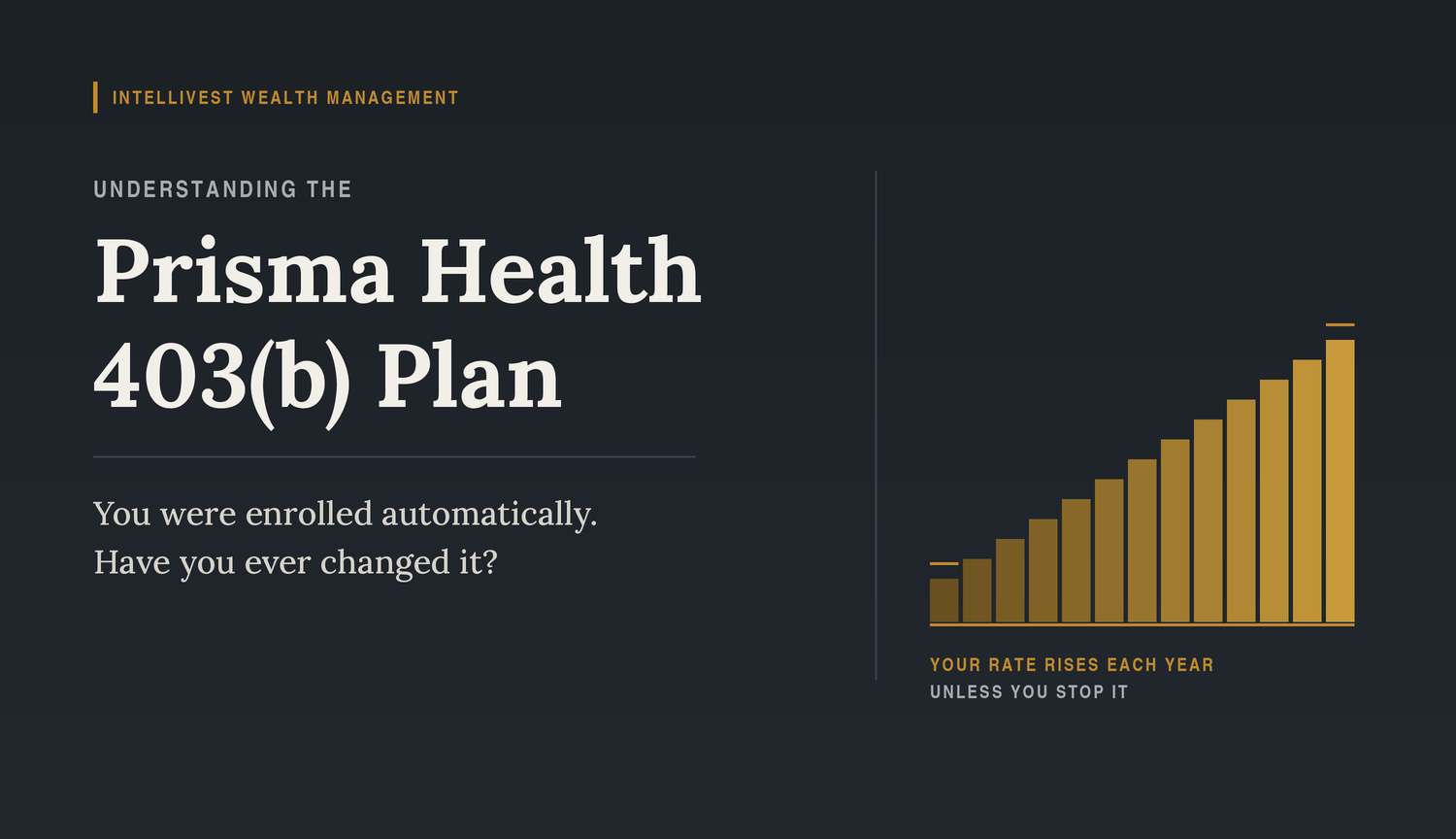
There's also an automatic increase feature. Your rate rises 1% each year until it reaches 15%, unless you stop it.
That's a well-designed default, and it's better than the alternative — plenty of people would never enroll at all. But there's something unusual about Prisma's plan that makes the default matter more here than it would elsewhere.
Most plans have a number that tells you where to stop. At an employer matching 100% of your first 4%, the answer is obvious: contribute at least 4%. The match is a signpost.
Prisma's match works differently. It's discretionary — the company decides each year whether to fund it — and for the plan year ended December 31, 2024, it wasn't funded at all. When a match is made, it lands in the 401(a) plan rather than this one.
So there's no signpost. Nothing in the plan is telling you what the right number is. For most Prisma employees, the 3% default is doing the entire job of answering a question they never got asked.
What 3% Actually Builds
Some context on what these rates produce. Take someone earning $65,000:
3% — $1,950 a year
6% — $3,900 a year
10% — $6,500 a year
15% — $9,750 a year
Over a long career the gap widens considerably. Assuming a 7% average annual return over 30 years, with level contributions:
Contributing 3%: about $184,000
Contributing 10%: about $614,000
Contributing 15%: about $921,000
Those figures cover only your own 403(b) contributions. Prisma's 3% nonelective contribution to the 401(a) plan sits on top of them, as would any match in a year one is funded.
A word on what to do with that. We're not going to tell you 3% is wrong — for plenty of people it's genuinely what fits right now, and saving something consistently beats saving more and stopping. What we'd say is that 3% was chosen by a default setting, not by you, and it's worth at least making it a decision. Even moving up one or two percentage points, or letting the automatic increase run rather than turning it off, changes the picture materially.
These are hypothetical illustrations. They assume a constant 7% annual return, which no real investment provides, and level contributions with no salary increases. They are not projections of any actual investment and your results will differ.
How Much You're Allowed to Contribute
The plan permits deferrals of up to 100% of your pretax annual compensation — far more than IRS limits allow in practice, so the federal contribution limit is what binds, not the plan.
If you're 50 or older before the end of the plan year, you're eligible to make catch-up contributions on top of the standard limit.
The plan also accepts rollovers from other qualified plans, including both defined benefit and defined contribution plans. If you've got a 401(k) sitting at a former employer, consolidating it here is an option worth weighing.
Your Money Is Yours Immediately
Participants are vested immediately in their own contributions plus actual earnings on them.
No schedule, no waiting period, nothing forfeited. Every dollar you contribute is yours from the moment it's withheld, and it goes with you whenever you leave.
This is worth stating clearly because the companion plan works differently. Prisma's contributions to the 401(a) vest after three years of credited service — and employees who leave before then forfeit that money. Your own contributions in this plan are never subject to that.
If you're weighing a departure, that's the distinction that matters: this account travels with you no matter what. The other one may not.
The Flexible Account: Loans and Hardship Withdrawals
Between your two Prisma accounts, this is the one with options.
Loans. You may borrow a minimum of $1,000, up to the lesser of $50,000 or 50% of your vested account balance. The loan is secured by your account balance. The interest rate is set when the loan originates and must be comparable to commercial lending rates. Principal and interest are repaid through biweekly payroll deduction.
Hardship distributions. Permitted upon demonstration of financial hardship.
Neither is available from the 401(a) plan — it stopped allowing new loans in 2010 and doesn't provide for hardship distributions. So in a genuine emergency, this is the account with room to move.
That said, both come with real costs. A loan pulls money out of the market while you repay it, and an unpaid balance can become a taxable distribution if you leave Prisma. A hardship distribution is taxable and may carry a 10% penalty if you're under 59½. Worth understanding fully before either one.
When You Can Take the Money Out
On termination of service. You may elect to receive the value of your vested interest as a lump sum or in installments as the plan provides. Since your contributions are always fully vested, that's your entire balance.
At age 59½. All fully vested balances become available for distribution.
Financial hardship. Available on demonstration of hardship, as above.
This is another place the two plans diverge — the 401(a) has only the first two triggers.
Leaving Prisma: Your Options
Your 403(b) balance is entirely yours, so this is purely a question of where it's best held.
Leave it in the Prisma plan. A plan this size often has access to institutional pricing you can't get retail. Prisma also pays certain plan expenses directly, which keeps participant costs lower than they'd otherwise be. Worth comparing before you move anything.
Roll it into your new employer's plan. Keeps the money in a workplace plan, which preserves stronger creditor protection than an IRA in most situations. If you separate from service in or after the year you turn 55, you can also access workplace plan money without the 10% early distribution penalty — a benefit you give up by rolling to an IRA.
Roll it into an IRA. Opens a wider investment universe and allows this balance to be managed alongside everything else you own. Use a direct trustee-to-trustee transfer — an indirect rollover triggers 20% mandatory withholding and a 60-day deadline.
Cash it out. Ordinary income tax, plus a 10% penalty if you're under 59½. Rarely the right answer.
One complication specific to Prisma: you have two accounts with different rules, and the right decision for one isn't automatically right for the other. If your 401(a) isn't vested yet, that alone may be worth factoring into your timing. If you'd like a second opinion, our consultations are complimentary.
FAQ
What is the Prisma Health Retirement Savings Plan?It is Prisma Health's 403(b) plan — the account holding the retirement contributions you make from your paycheck. It covers substantially all Prisma Health employees who are not independent contractors.
Am I automatically enrolled in the Prisma 403(b)?Yes. All newly eligible employees are automatically enrolled unless they affirmatively elect not to participate. The default deferral rate is 3% of eligible compensation, invested in custom model portfolios until you change it.
Does my Prisma contribution rate increase automatically?Yes. Your deferral rate increases by 1% each year until it reaches 15%, unless you elect to stop the automatic increases.
How much can I contribute to the Prisma 403(b)?The plan permits up to 100% of your pretax annual compensation, subject to IRS limits. Participants who reach age 50 before the end of the plan year may also make catch-up contributions.
When am I vested in the Prisma 403(b)?Immediately. You are vested in your own contributions plus earnings at all times.
Can I take a loan from my Prisma 403(b)?Yes. A minimum of $1,000 up to the lesser of $50,000 or 50% of your vested account balance, secured by your account and repaid through biweekly payroll deduction.
Can I take a hardship withdrawal from my Prisma 403(b)?Yes. Hardship distributions are permitted upon demonstration of financial hardship.
Can I roll an old 401(k) into my Prisma 403(b)?Yes. The plan accepts amounts representing distributions from other qualified defined benefit or defined contribution plans.
Why do I have both a 403(b) and a 401(a) at Prisma?The 403(b) holds the contributions you make from your paycheck, vested immediately. The 401(a) holds Prisma's employer contributions, which vest after three years of credited service. They are separate plans with different rules.
Who holds the Prisma Health Retirement Savings Plan?Empower Retirement, LLC serves as trustee, with Empower Annuity Insurance Company of America and The Variable Annuity Life Insurance Company as custodians.
Disclosure
IntelliVest Wealth Management is a Registered Investment Advisor headquartered in Spartanburg, South Carolina. This is not a solicitation or financial advice, and this article should only be used for educational purposes. Plan details are drawn from the Prisma Health Retirement Savings Plan's audited financial statements for the plan year ended December 31, 2024 and were accurate as of that filing. Plan provisions may change. Hypothetical illustrations do not represent actual investment performance. Confirm your own plan provisions against your Summary Plan Description and current plan materials, and consult IntelliVest Wealth Management about your personal financial situation.